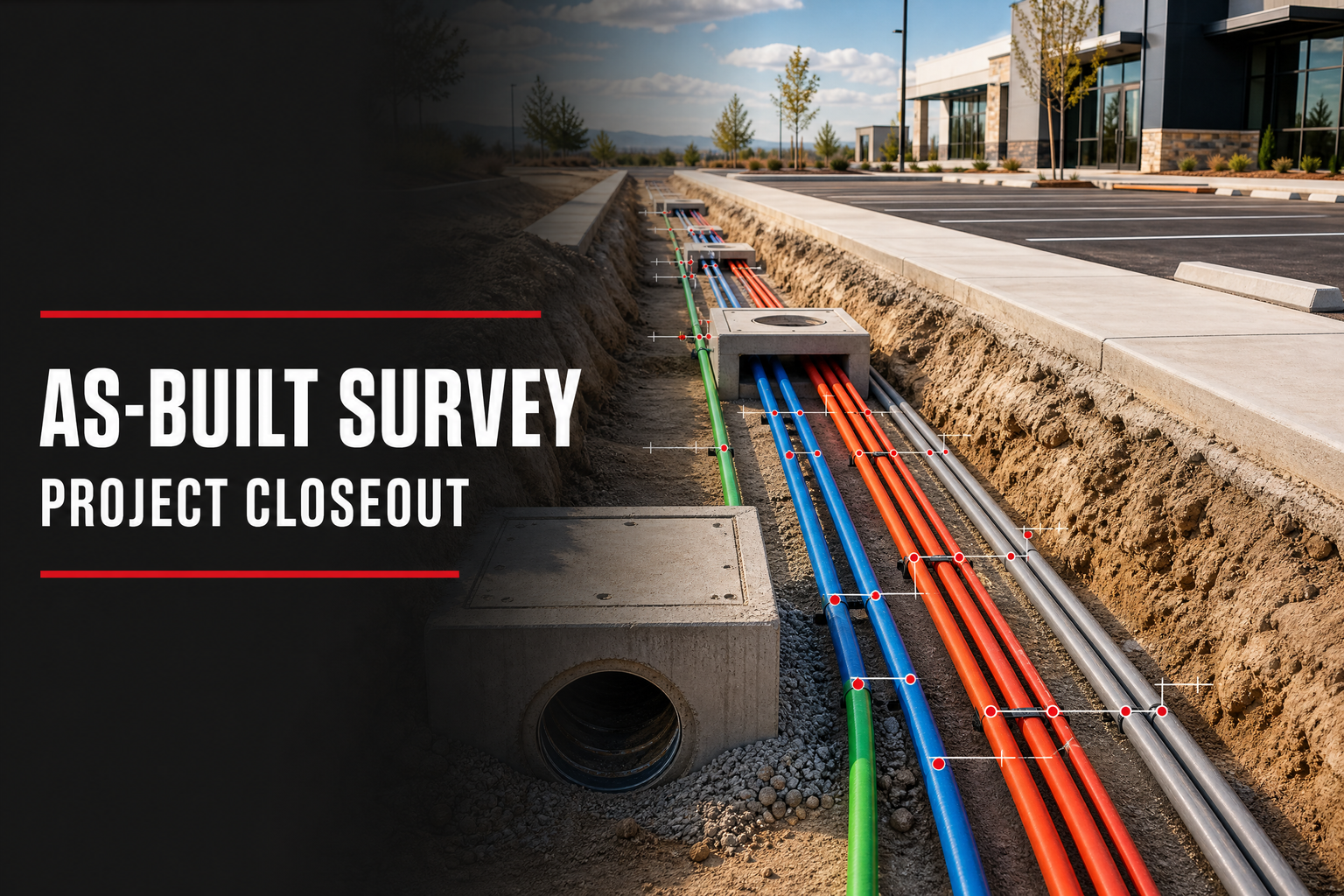
An as-built survey records selected completed improvements after construction. For Utah commercial projects, it gives owners, contractors, engineers, utilities, and agencies a field record before closeout, turnover, occupancy, maintenance, or future expansion.
Quick answer: An as-built survey documents completed work within scope. It can support records, closeout coordination, utility documentation, and future planning. It does not replace inspection approvals, design review, certification, or project-specific requirements.
What an As-Built Survey Documents
The scope should be defined before field work begins. Depending on the project, the survey may record selected horizontal and vertical locations of completed work, including buildings, utilities, curb and gutter, pavement, drainage features, retaining walls, sidewalks, accessible routes, or other visible elements.
The needed detail, control, format, and certification depend on the decision the record will support. Identify features, timing, and recipients early rather than asking the surveyor to infer requirements after construction.
| Closeout need | How survey records can help | Confirm with the project team |
| Final project record | Documents selected completed improvements within scope | Required features, tolerances, and format |
| Utility turnover | Supports records for installed facilities | Owner, utility, agency, and electronic-record requirements |
| Owner handoff | Creates a reference for maintenance and future work | Intended users and record standards |
| Design coordination | Provides field information for review against plans | Engineer’s review process and responsibility |
| Agency closeout | Supplies survey information when required | Jurisdiction, permit, and inspection requirements |
Why Closeout Records Matter
Preserve Information Before It Is Lost
Once a trench is backfilled, landscaping is installed, or a project is occupied, it may be harder to document selected features, locations, and elevations. Early collection reduces reliance on memory, photographs, or incomplete records.
Organize Turnover
Salt Lake City’s current closeout guidance says project closeout can require final approvals, special-inspection signoff, approved closeout documents, and other documents or test results requested by project inspectors. It also states that a Certificate of Occupancy requires applicable signoff from Transportation, Engineering, and Public Utilities.
An as-built survey is not automatically required for every commercial project, and it is not a substitute for those approvals. It can provide a defined survey record when the owner, engineer, utility, contract documents, or agency calls for it.
Support Future Decisions
A useful record reduces uncertainty when an owner considers repairs, utility work, site modifications, sale, or redevelopment. Design it for likely users instead of treating it as a last-minute task.
Requirements Vary by Utah Project
Actual requirements depend on the owner, contract, design, utility, agency, and jurisdiction. For example, UDOT states that its underground utility facilities must be collected to survey-grade accuracy and that electronic as-built records are to be delivered with each permit or project. This is a specific UDOT requirement, not a claim that every private Utah development has the same standard.
Salt Lake City’s commercial and multifamily checklist identifies property lines, site infrastructure, a topographic survey, grading plan, and slope analysis among relevant site-plan materials. Confirm the records needed with the engineer, utility, agency, inspector, and permitting authority for the actual project.
Plan the Survey Before the Last Week of Construction
Coordinate field access and collection milestones during preconstruction or early construction. Consider the work when:
•Critical improvements will be covered before final completion.
•The owner, utility, engineer, public agency, lender, or contract documents call for a final record.
•The team needs documentation for turnover, inspection, occupancy, or maintenance.
•Field changes could affect final plans, utility records, or future site work.
Cook Surveying’s land-surveying and geomatics services support commercial development, construction and design surveys, aerial mapping, utilities, and spatial-data needs throughout Salt Lake City and the Wasatch Front.
Give the Surveyor the Right Information
Before requesting an as-built survey, share:
•The approved plan set, revisions, and the improvements to be documented.
•Control information, design coordinates if applicable, required datum, and file format.
•The owner, utility, lender, agency, or engineer requirements defining the deliverable.
•Construction schedule, site contacts, safety requirements, and dates when features will be exposed or complete.
Frequently Asked Questions
Is an as-built survey the same as a final inspection?
No. It is a survey deliverable within its agreed scope. Final inspection and approval are separate processes controlled by the applicable authority or project requirements.
Does every Utah commercial project need one?
No. Confirm the project-specific requirements early with the owner, utility, engineer, agency, and jurisdiction.
Can buried utilities be documented after backfill?
It may be difficult or impossible to document selected concealed features after backfill. Coordinate collection milestones before work is covered.
Make the As-Built Survey Part of Closeout
Why does an as-built survey matter at project closeout? It turns selected completed work into usable project information before access changes and important conditions disappear. By defining the scope, timing, and recipients early, Utah commercial teams can support closeout, handoff, utility coordination, maintenance, and future decisions.
Cook Surveying & Associates serves developers, contractors, owners, utilities, public agencies, engineers, and commercial clients from Salt Lake City. To discuss construction, as-built, utility, or closeout survey support, call (801) 364-4051 or email contact@cook-surveying.com.
References
[1] Salt Lake City Building Services — Closeout Guidance
[2] Utah Department of Transportation — Utilities
[3] Salt Lake City Building Services — Commercial / Multi-Family Login Checklist